
By Flavia Oyuu, Communications Office, Llira Diocese
LIRA, Uganda – Lira Diocese has reaffirmed its commitment to strengthening the Paternity of St. Joseph, commonly known as the Men’s Guild, following a three-day formation and mentorship visit by leaders of the Men of St. Joseph International movement.
The visit brought together the movement’s International representative Richard “Dick” Kiernan from the Diocese of Manchester in New Hampshire, USA, National Coordinator Paul Katuramu, and Gulu Provincial Coordinator Libolio Otim Kithaghenda. They held meetings with Men’s Guild leaders, visited parish initiatives and shared practical strategies aimed at strengthening Catholic men as leaders in their families, communities and the Church.
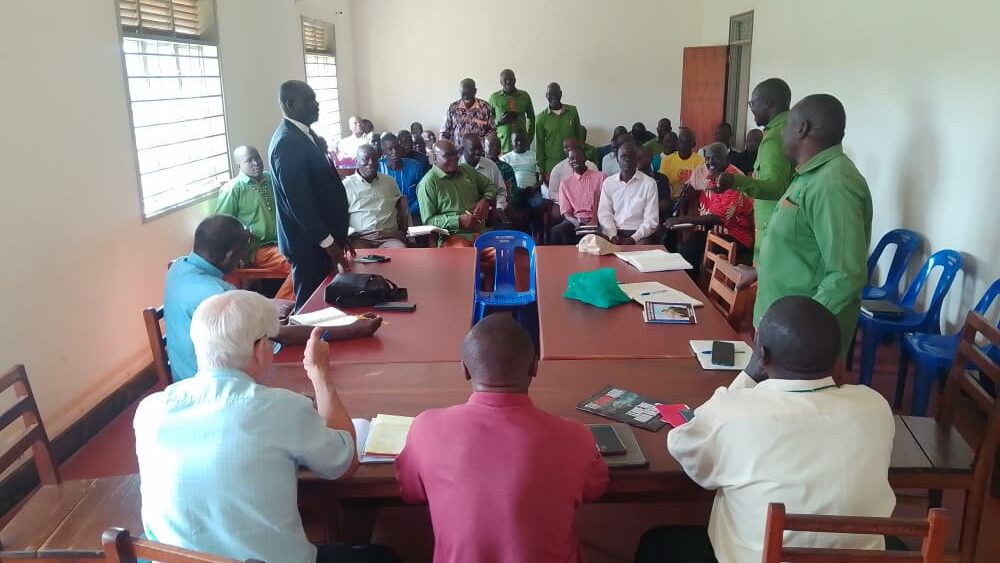
The visit concluded at the diocesan offices in Bar Ogole with a meeting attended by the Vicar General of Lira Diocese, Msgr. Innocent Valente Opio, Ngetta Deanery Dean Rev. Fr. Simon Peter Olugu, the chaplain of the Paternity of St. Joseph and members of the Men’s Guild.
Speaking at the closing meeting, Msgr. Opio said the Church’s synodal journey requires greater participation from men, noting that many have increasingly become spectators rather than active participants in parish life.
“The Church is now going very synodal, where participation of all is highly encouraged and nobody is left behind,” he said. “The mothers and the fathers are the pillars of the Church. If there is any lay movement that should never be left behind, it is that of the mothers and the fathers because they are fundamental to the life of the Church.”
He urged members of the Men’s Guild not to be discouraged by their current numbers, comparing the movement to the mustard seed that grows into a great tree.
“You are the hope of the Church and the hope of the Diocese. If you remain committed, the impact of your efforts will be evident in the years to come,” he added.
The Vicar General also emphasized that strengthening families begins with fathers, urging men to take a leading role in family catechesis and faith formation.
He observed that many young people drift away from the Church because Christian values are no longer being nurtured within families as they once were.
“We learnt to pray at home before we even went to school. Family catechesis is very important, and it begins with fathers and mothers taking responsibility.”
Msgr. Opio also highlighted the diocesan vision of promoting economic empowerment among lay associations through savings and cooperatives, saying financially stable groups would be better positioned to support parish activities and reduce dependence on collections.
The National Coordinator of Men of St. Joseph Uganda, Paul Katuramu, described the movement as a lay apostolate dedicated to helping men grow in faith, become better husbands and fathers, and serve both their families and the Church.
He shared how the movement began in Kasese Diocese and has since expanded to 14 Catholic dioceses in Uganda and several other African countries including the Democratic Republic of Congo, Rwanda and Nigeria.
Katuramu encouraged members to embrace both spiritual growth and economic empowerment.
“We have realised that men are suffering both spiritually and economically. We encourage our members to pray, work hard and support their families so that they can also support the Church.”
He further called on members to welcome every man into the movement regardless of his circumstances, stressing that formation should precede judgment.
“Leave no man behind,” he said.
Gulu Provincial Coordinator Libolio Otim Kithaghenda reminded participants that St. Joseph remains the model of Christian fatherhood and responsible leadership.
He said the movement seeks to raise “heroic men” who become disciples in their homes, parishes and communities by following the example of St. Joseph.
Drawing from Acts 1:8, he challenged members to become missionary disciples who share the Gospel beyond their immediate communities.
Richard Kiernan, who also serves on the global leadership of Men of St. Joseph International, encouraged the Diocese to invest in leadership formation by multiplying trainers who can establish strong parish groups.
Sharing the experience of the movement’s growth in the United States and internationally, he stressed that effective Catholic men’s ministry depends on prayer, small faith-sharing groups, leadership development and strong parish support.
“Our mission is to multiply disciples and multiply leaders,” he said, noting that Uganda has become one of the fastest-growing countries within the international movement.
He praised the rapid expansion of the movement in Uganda and expressed hope that East African representatives would participate in the next global Men of St. Joseph conference scheduled for Rome in 2027.
Rev. Fr. Simon Peter Olugu thanked the visiting delegation for strengthening the Diocese and expressed confidence that Lira Diocese would continue growing as a self-sustaining local Church.
“You have not simply given us fish to eat; you have taught us how to fish,” Fr. Olugu said. “When you return, you will find us at a different level because we have the leadership, the commitment and the resources to move forward.”
Men’s Guild Coordinator Jimmy Agnes Bongo said the visit enabled the delegation to appreciate several initiatives already being undertaken by guild members, including agricultural training, poultry keeping, fish farming, rabbit rearing and environmental conservation projects in various parishes.
He said discussions also focused on the challenges facing men and strategies for attracting more Catholic men into the fraternity while promoting spiritual growth alongside economic empowerment.
As part of its future activities, the Paternity of St. Joseph plans to organize a diocesan marathon and health camp aimed at increasing awareness of the movement, promoting men’s health and encouraging greater participation in Church life.
“We want to build strong men and strong communities,” Bongo said. “We invite all men to become part of this fraternity so that together we can strengthen our families, our Church and society by following the example of St. Joseph.”
Recent Comments