
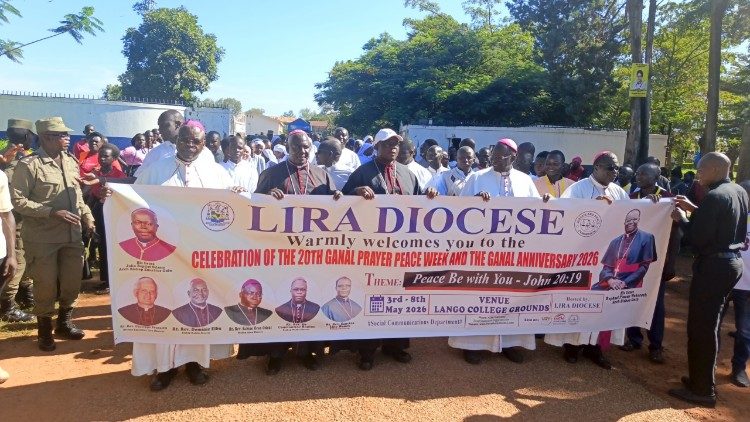
At the 20th anniversary of the GANAL Provincial Prayer Peace Week in Lira, Archbishop Raphael p’Mony Wokorach challenged Christians to move beyond silence and passive coexistence, urging them instead to become active builders of reconciliation, justice, mercy, and lasting peace.
By Flavia Oyuu, Communications Office, Lira Diocese
The second day of the 20th GANAL Provincial Prayer Peace Week and Anniversary Celebrations at Lango College in Lira City was marked by a profound spiritual reflection delivered by Raphael p’Mony Wokorach under the theme “Spiritual and Moral Foundation for Peace.”
Drawing from Matthew 5:9, “Blessed are the peacemakers, for they shall be called children of God” and Psalm 85:10, the Archbishop delivered a deeply theological and socially reflective presentation that resonated with more than 400 pilgrims gathered from the four dioceses of the GANAL Ecclesiastical Province together with Kotido Diocese.
Held from 3rd to 8th May 2026 under the overall theme “Peace Be With You” (John 20:19), this year’s Prayer Peace Week carried special significance as the Church commemorated twenty years since the initiative was launched in January 2006 in the aftermath of Northern Uganda’s insurgency.
The annual gathering, first inaugurated by Cardinal Emmanuel Wamala, was born out of the urgent need for healing, forgiveness, reconciliation, and communal restoration following years of violence and displacement in Northern Uganda.
Today, although armed conflict has largely subsided, Church leaders say the region continues to suffer from the lingering wounds of war, including poverty, domestic violence, trauma, suicide, mistrust, mental breakdown, and insecurity caused by cattle rustling in Karamoja and surrounding areas.
In his presentation, Archbishop Wokorach warned against reducing peace to mere silence or the absence of violence.
“Jesus did not say, ‘Blessed are the peacekeepers.’ He said, ‘Blessed are the peacemakers,’” the Archbishop emphasized.
He observed that many societies mistake silence for peace while injustice, corruption, oppression, and fear continue beneath the surface.
Using the image of the “three wise monkeys” one refusing to see, another refusing to hear, and another refusing to speak the Archbishop cautioned that passive silence suffocates true peace rather than building it.
“A peacemaker is never passive,” he said.
The Archbishop also criticized modern approaches that focus only on compensation and legal settlements without addressing wounded hearts.
“True peace comes where reconciliation is attained,” he noted, adding that reconciliation requires metanoia a conversion of heart and mind.
Throughout his presentation, Archbishop Wokorach repeatedly stressed that peace is fundamentally a gift of God and cannot be separated from spiritual renewal.
Quoting St. Augustine’s famous words from The Confessions, he reminded the faithful:
“You have made us for Yourself, O Lord, and our hearts are restless until they rest in You.”
According to the Archbishop, modern humanity often seeks fulfillment in material success, wealth, achievements, or power while neglecting God, the true source of peace.
He challenged Christians to anchor their lives in God if they are to become authentic peacemakers in society.
The Archbishop further explored the biblical understanding of peace through the Hebrew concept of Shalom and the Greek idea of Eirene, both of which describe peace not merely as calmness, but as harmony, justice, wholeness, prosperity, friendship, and right relationship with God and neighbor.
“Peace is more than conflict resolution,” he said. “Peace is linked to justice, prosperity, mercy, and truth.”
Referencing the continued struggles in countries such as the Democratic Republic of Congo and South Sudan, Archbishop Wokorach observed that global institutions often prioritize “peacekeeping” while neglecting the deeper work of reconciliation and justice necessary for lasting peace.
The Archbishop also reflected extensively on Jesus’ relationship with the law, explaining how Christ fulfilled rather than abolished the law by placing mercy at its center.
Quoting Hosea 6:6 “I desire mercy, not sacrifice” he explained that mercy remains the very heart of God and the foundation upon which lasting peace must stand.
“We cannot understand the law without mercy. We cannot fulfill the law without mercy. We cannot know the heart of God without mercy,” he said.
In one of the most striking sections of his presentation, Archbishop Wokorach turned his attention to Uganda’s recent political climate following the general elections.
He called upon the nation to seek God’s forgiveness for what he described as moral failures during the campaign period.
The Archbishop condemned the misuse of God’s name in political rhetoric, where some leaders were equated to the Holy Trinity.
“Let the blasphemy of our time not become an internal scandal,” he warned.
He also lamented corruption, violence, injustice, and the worship of power over compassion.
“We worshipped force, not compassion,” he said. “People were hurt, people were killed, people were jailed.”
Calling for national conversion and moral renewal, the Archbishop urged Ugandans to allow God back into every sphere of society.
“Let God enter our Parliament, our homes, our banks, and even our barracks,” he appealed.
The reflections echoed the vision repeatedly emphasized throughout the week: that peace begins with reconciliation within the human heart before it can transform families, communities, nations, and the world.
Speaking earlier during an interview, John Baptist Odama described peace as “a treasure desired by every human person” and explained that the Prayer Peace Week was established to help communities recover spiritually and socially after the insurgency.
“We stand before God as sinful people and ask Him to help us not live in disorder among ourselves,” Archbishop Emeritus Odama said.
He emphasized that the initiative has always welcomed people across religions, tribes, and national boundaries, expressing a vision of “one humanity living in peace, promoting one another’s good, protecting one another, and journeying together.”
This year marked the second time Lira Diocese hosted the Prayer Peace Week celebrations.
As pilgrims continued with prayer, dialogue sessions, peace marches, and communal worship throughout the week, the message emerging from Lira was clear: peace cannot be reduced to political slogans or temporary calm, but must be rooted in truth, justice, mercy, reconciliation, and ultimately in God Himself.
“Peace be with you,” the Archbishop concluded, inviting Christians not only to speak about peace, but to live it with conviction.
End
Recent Comments