
By Flavia Oyuu, Communications Office, Lira Diocese
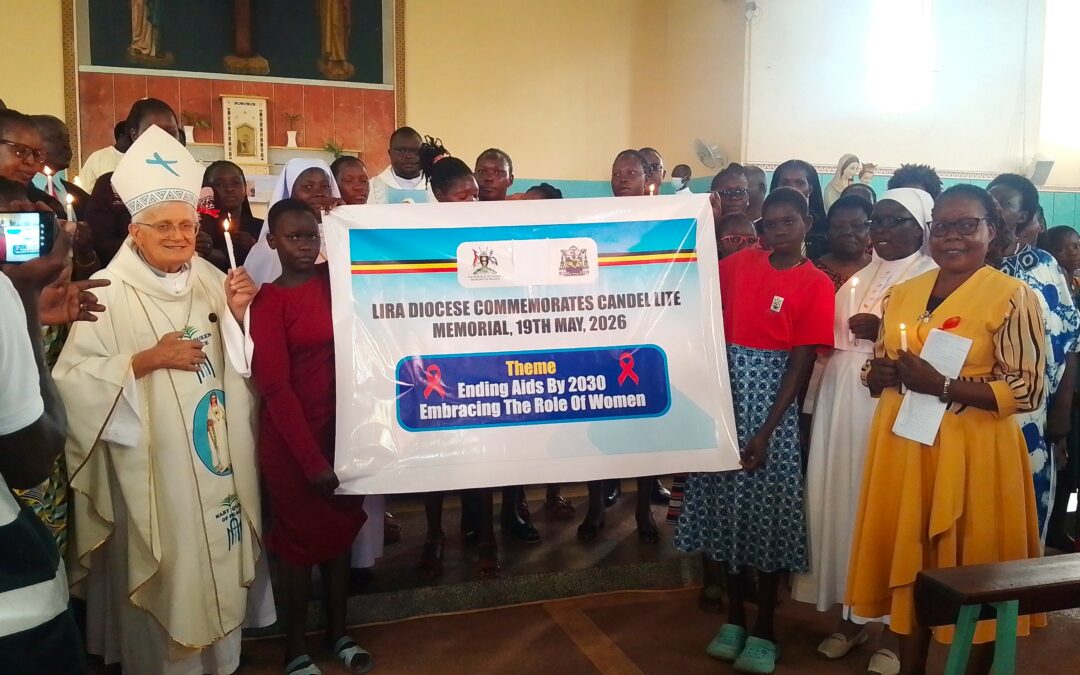
At the soft glow of candlelight inside Uganda Martyrs Cathedral, Christians of Lira Catholic Diocese joined the rest of the world on Sunday, 17 May 2026, to remember lives lost to HIV/AIDS and renew the call for compassion, awareness, and hope.
The diocesan commemoration of the International HIV/AIDS Candlelight Memorial was organized by the Diocese’s HIV/AIDS Focal Office in conjunction with the Uganda AIDS Commission during the 9:00 a.m. Mass attended by approximately 100–200 faithful.
Presiding over the Eucharistic celebration and candle-lighting ceremony was Rt Rev Joseph Franzelli, who reminded Christians that caring for the sick is part of the Gospel mission entrusted to the Church.
“God wants His children to be healthy and live a good life,” Bishop Franzelli said. “Spreading the Word of God and the Kingdom of God implies also taking care of sick people, for them to experience that God is not far away but is there with them.”
The memorial formed part of the global observance held annually in May to honor those who have died of HIV/AIDS and to stand in solidarity with people living with the virus. National celebrations in Uganda were held in Kampala on 19 May under the theme: “Ending HIV by 2030: Embracing the Role of Women.”
Inside the cathedral, women wearing red ribbons pinned to their chests walked prayerfully toward the pulpit as names of deceased persons were remembered in solemn reflection. In a deeply symbolic moment, Bishop Franzelli lit a candle from which women leaders present lit their own candles while prayers were offered for the souls lost to the pandemic.
Among those present was Resident District Commissioner, Josephine Omara Olili, representing women leaders and government officials at the memorial.
Speaking during the commemoration, Lira City HIV/AIDS Focal Person Hillary Okello described the memorial as a global moment of remembrance and renewed commitment in the fight against HIV/AIDS.
“This month is a very memorable month,” he said. “The World Health Organization has chosen to remember those who lost their lives to the HIV/AIDS pandemic, and we are all expected at least to light a candle in memory of those who have lost their lives.”
Okello noted that although Uganda has made significant progress over the years, new infections remain a serious concern, especially among women and young girls.
“Lira City alone is having 350 new infections, and the majority of these are still women and young girls,” he explained.
According to Okello, Uganda currently has an HIV prevalence rate of 5.2%, while more than 20,000 people continue to die annually from HIV-related illnesses despite advancements in treatment and prevention.
He emphasized Uganda’s commitment to the global 95-95-95 targets, which aim to ensure that 95% of people know their HIV status, 95% of those diagnosed begin treatment, and 95% of those on treatment achieve viral suppression.
“When they are suppressed, the chances of transmitting the disease become much more limited,” he said.
The Diocesan HIV/AIDS Focal Person, Dina Apio, said the Church continues to play a vital role in combating stigma and mobilizing communities toward prevention and care.
“As Christians, we stand in solidarity with the people living with HIV in our midst,” she said.
Apio highlighted the disproportionate burden HIV/AIDS continues to place on women, pointing to domestic violence, harmful cultural practices, poverty, and limited access to treatment as major contributing factors.
“When you look at the prevalence rates, we have more women suffering from the disease or infected than the men,” she explained. “Nationally, we are talking about 750,000 women out of the 1.5 million people living with HIV/AIDS.”
She further revealed that the Lango sub-region currently has approximately 96,200 people living with HIV/AIDS, despite recent improvements in prevalence rates within Lira City.
“Much as our recent statistics indicate that we have reduced prevalence from 12% in Lira City to 9%, there is still a call for more action,” she said.
The diocesan memorial also included free HIV testing and counselling services, as well as sickle-cell testing and counselling, offered to participants after Mass as part of the Church’s pastoral and health outreach.
For many who attended, the candlelight memorial was more than an event. It was a moment of prayer, remembrance, healing, and renewed determination to end stigma while restoring hope to affected families and communities.
As candles flickered across the cathedral, the message remained clear: the fight against HIV/AIDS is not only medical, but also spiritual, social, and deeply human — a mission that calls the Church, government, health workers, and communities to walk together in compassion and hope.
End
Recent Comments