
By Flavia Oyuu, Communications Office, Lira Diocese
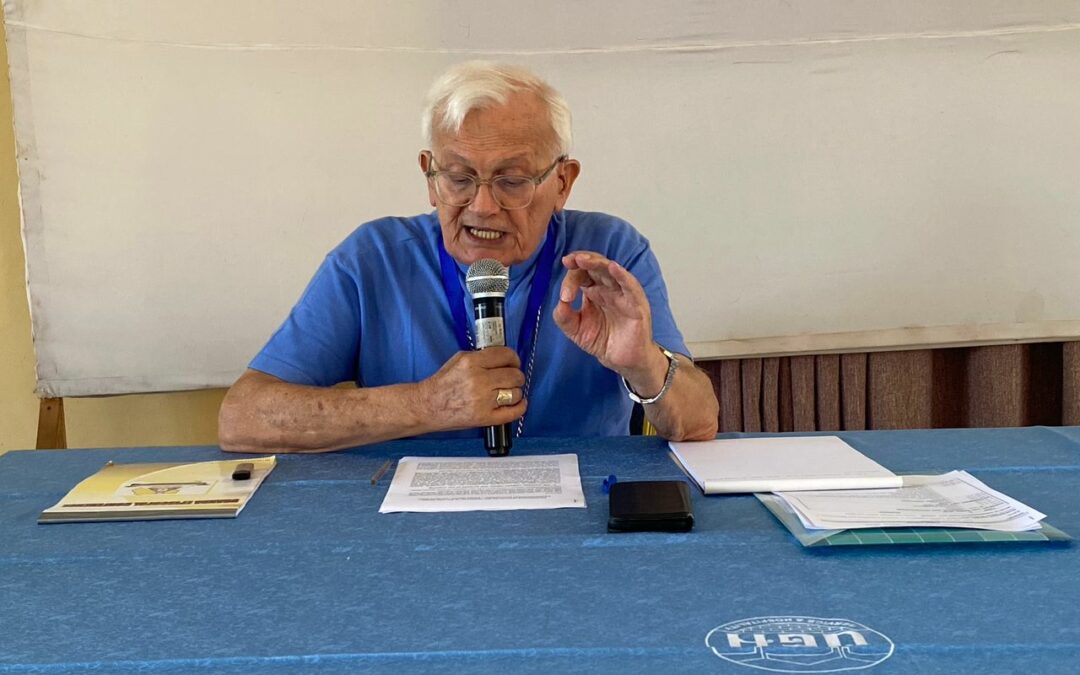
ULRIKA, Uganda – April 21–26, 2026 – Catholic communicators from all 19 dioceses of Uganda gathered at Ulrika Guest House for the National Communications Week workshop, where Rt. Rev. Joseph Franzelli, Bishop Emeritus of Lira Diocese and Chairperson for Social Communications at the Uganda Episcopal Conference, reflected deeply on the Holy Father’s message for World Communications Day titled “Preserving Human Voices and Faces.”
The annual Communications Week, held ahead of the World Communications Day celebrations, brings together Church communicators to reflect on the Pope’s message and its relevance to pastoral communication in Uganda. This year’s gathering focused on the growing influence of Artificial Intelligence (AI) and its implications for human communication.
Speaking to the participants, Bishop Franzelli emphasized that the purpose of the workshop is not only to study the Pope’s message but also to understand it deeply and translate it into local pastoral contexts.
“This Communication Week is meant to make us aware of different aspects of communication, as the Pope enlightens us each year on a particular dimension,” he said. “We are called to reflect, understand, and eventually go back to our dioceses to convey the same message in a way that speaks to our people.”
He stressed the importance of unity in communication within the Church, noting that communicators are called to work in synodality—together, under the guidance of the Holy Father.
“We must work in the same direction under the guidance of Peter, who for us today is Pope Leo XIV,” he added.
Preserving Human Identity in a Digital Age
Reflecting on the theme “Preserving Human Voices and Faces,” Bishop Franzelli highlighted the uniqueness and sacredness of human identity.
“Our faces and voices are unique because they reveal who we are,” he said. “They are not just physical features, but expressions of our identity, and for believers, they are sacred because we are created in the image and likeness of God.”
He reminded participants that God is a communicating God who revealed Himself through creation, prophets, and ultimately through Jesus Christ—the Word made flesh with a human face and voice.
“This is the gift we are called to receive, live, and communicate,” he said.

Artificial Intelligence: Opportunity and Risk
Bishop Franzelli acknowledged the benefits of Artificial Intelligence in modern communication but warned of its risks if not properly understood and guided.
The Pope’s message, he explained, appreciates technological progress while cautioning against its negative impact on human relationships and authentic communication.
“The challenge is not only technological but anthropological,” he said. “It touches our understanding of what it means to be human, created in God’s image.”
He warned that over-reliance on AI could weaken critical thinking, creativity, and personal responsibility.
“When we allow machines to think for us, we risk becoming passive consumers of ideas we never created,” he noted. “Even simple reasoning is being replaced by quick answers from devices, and this weakens our ability to think and create.”
Risk of a ‘World of Mirrors’
The Bishop further cautioned against what he described as a “world of mirrors,” where people interact more with digital images than with real human beings.
“Communication is an encounter between persons,” he said. “But today, we risk living in a world where we only see images and never truly meet people.”
He also raised concern about bias in digital systems, noting that algorithms are shaped by the values and interests of their creators, which may influence how information is presented.
“This can subtly shape our worldview and even normalize injustice,” he warned.
Call for Discernment and Responsibility
While acknowledging the inevitability of digital innovation, Bishop Franzelli urged communicators to approach Artificial Intelligence with discernment and responsibility.
“The task before us is not to stop technological development, but to guide it wisely,” he said. “AI must remain an ally, not a master.”
He outlined three guiding principles for responsible engagement with technology: responsibility, cooperation, and education.
“Each of us has a responsibility to contribute to truth and integrity in communication,” he emphasized. “No one is exempt from this duty.”
Conclusion
The Communications Week workshop concluded with a renewed call for Catholic communicators to safeguard human dignity in the rapidly evolving digital landscape.
As the Church continues to engage with emerging technologies, Bishop Franzelli’s message underscored the enduring importance of authentic human connection, truth, and discernment in communication ministry.
Recent Comments