
By Flavia Oyuu, Communications Office, Lira Diocese
The Bishop of Lira Diocese, Rt. Rev. Sanctus Lino Wanok, has called upon members of the Catholic Charismatic Renewal (CCR) to strive for financial independence before engaging in ministry, cautioning that dependence on those they minister to can undermine their service.
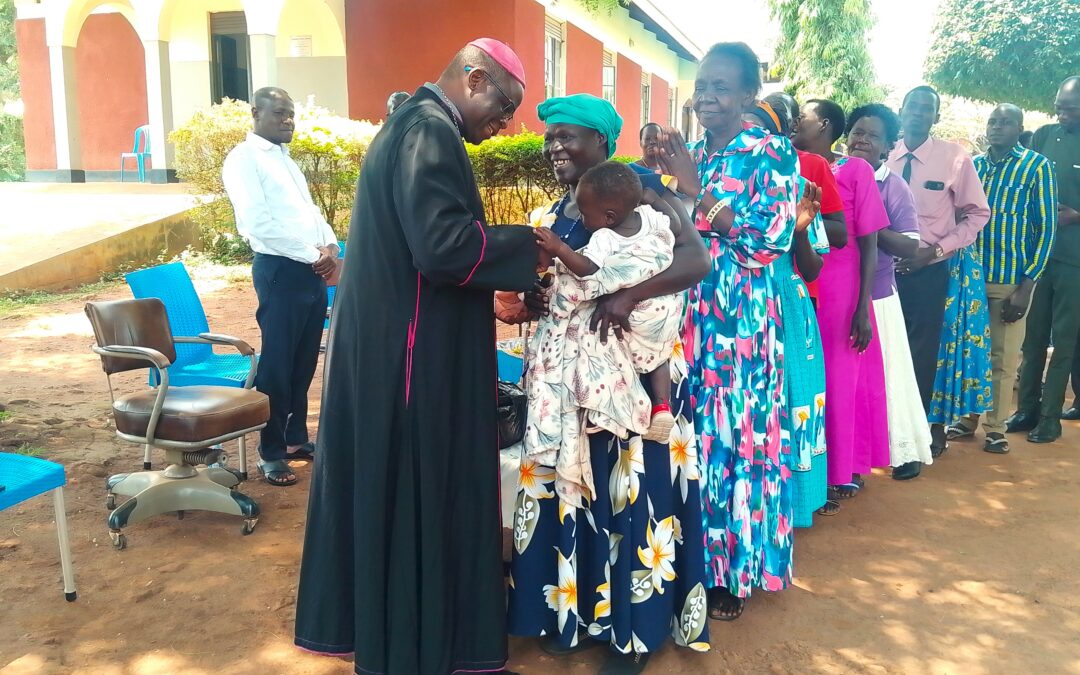
The Bishop made the call on Tuesday, February 25, 2026, during a courtesy visit by CCR diocesan leaders at his temporal residence at Nazareth Family Center, as his permanent residence nears completion.
The CCR leaders used the visit to seek pastoral guidance from the Bishop on various challenges facing the movement in the diocese.
Bishop Wanok observed that fear remains one of the major obstacles hindering effective ministry within the CCR. He likened this to the biblical story of Jonah, who initially feared preaching to the people of Nineveh and attempted to flee, only to be renewed after spending three days in the belly of a fish before courageously proclaiming God’s message.
He encouraged CCR members to renew their faith, repent, and begin afresh with courage and strength drawn from God in their ministry.
Drawing inspiration from St. Paul, who supported himself as a tent maker, the Bishop urged CCR members to have sustainable sources of livelihood to ensure financial stability, rather than relying on those they serve spiritually.
Emphasizing practical self-reliance, Bishop Wanok reiterated his vision that every household in the diocese should aim to rear at least 100 chickens as a means of livelihood. He said this initiative would also support those engaged in ministry to serve freely without financial pressure.
The Bishop further noted the importance of the CCR movement in the Catholic Church and urged its members to embrace humility, set aside pride, and dedicate themselves fully to serving God.
Speaking during the visit, Rev. Fr. Morris Otyang, the Spiritual Director of CCR Lira Diocese, explained that the meeting is an annual engagement during which CCR leaders present reports, share challenges, seek guidance, and receive blessings from the Bishop.
Fr. Otyang noted that some parishes have never participated in CCR meetings, raising concerns about the movement’s visibility across the diocese. He explained that limited parish participation makes it difficult to organize crusades and ministry activities, which would otherwise help Christians better understand CCR.
He added that many Christians mistakenly associate CCR only with healing and deliverance, yet the movement also runs programs in evangelization and outreach, scripture study and formation, social justice and charity, and ecumenical engagement, among others.
Fr. Otyang also reported that the leaders who met the Bishop were recently elected and are working well together. As part of their responsibilities, they mobilized resources to facilitate training for about 20 priests and religious in healing and deliverance at the Emmaus Center, Katikamu.
He noted with pride that Lira Diocese has consistently performed well in training programs at Emmaus Center, resulting in a strong pool of trained Emmaus Pastoral Workers (EPWs) to support pastoral activities. However, he cited poor coordination within the Gulu Ecclesiastical Province as a continuing challenge.
Meanwhile, Abibi Tonny Albo, the Provincial Coordinator of the Gulu Ecclesiastical Province, thanked the Bishop for granting the CCR leaders audience despite his busy schedule. He informed the Bishop about the ongoing construction of the Upper Room Spiritual Center, a facility intended to serve as a hub for CCR programs and formation of the laity. He said financial constraints have hindered completion of the project, and the current structure is insufficient to accommodate the growing number of trained EPWs.
Albo further observed that the Diocesan Students Outreach Ministry is facing challenges, particularly in capacity building. He said limitations in public speaking skills, especially in English, have affected outreach to universities and secondary schools.
He, however, noted that despite these challenges, the Lira Diocese Students Outreach Team remains the best-performing in Uganda.
End
Recent Comments