
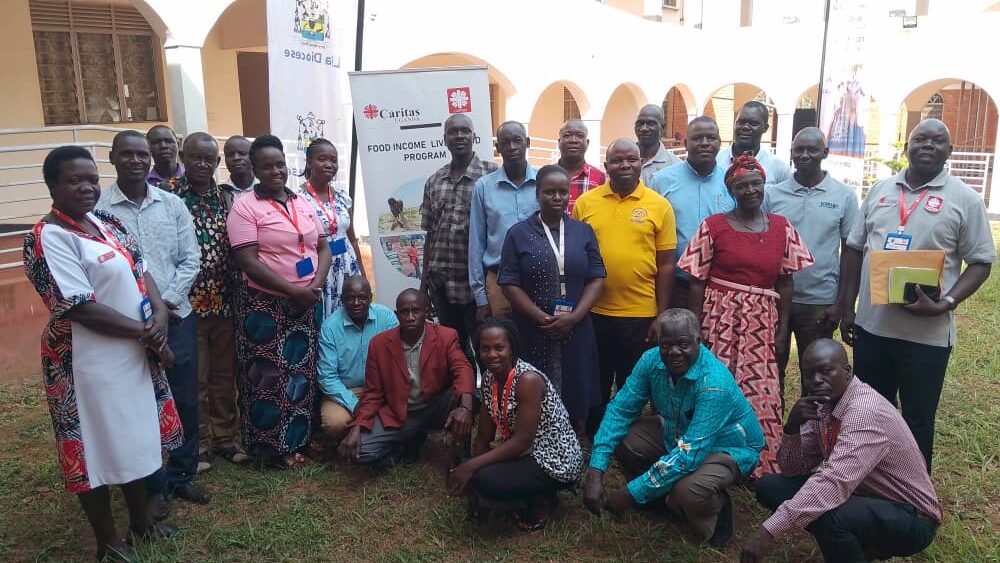
Training brings together Deans, agronomists, cooperative leaders and Caritas staff to strengthen livelihoods, climate resilience and household income across the Diocese.
By Flavia Oyuu, Communications Office, Lira Diocese
The Bishop of Lira Diocese, Rt. Rev. Sanctus Lino Wanok, has called on all Deans to lead by example by planting at least 100 cocoa seedlings in their respective deaneries. He made the appeal during a Training and Capacity-Building Workshop organized by Caritas Lira, in partnership with the Lira Diocese Multi-Purpose Cooperative Society (LDMCOS), held on 3rd December 2025 at St. Daniel Comboni Offices.
For years, Bishop Wanok has championed initiatives aimed at lifting families out of poverty across the Diocese. His latest focus is on promoting cocoa growing as a long-term income source, urging every deanery, parish, chapel, and household to establish at least one acre of cocoa, equivalent to 450 seedlings.
“Health is the foundation of life and progress”
In his opening remarks, the Bishop reflected on communion and the dignity of the human person, anchored on three dimensions of health: body, mind, and soul.
He emphasized that without good health, “families, Christians, and communities cannot progress.”
He also highlighted the Diocese’s six pastoral pillars, Catechesis, Health, Education, Communication, Accountability and Caritas, stressing that they are interconnected:
“Without health you cannot proceed. It is the basis of life for families, communities, and the whole nation. And you must have education, for it is a pillar in cooperative life.”
Bishop Wanok encouraged the clergy and lay leaders to use media constructively, build unity, practice accountability, and allow correction where necessary, noting that true Caritas—complete love of God—is born from these pillars.
He further urged communities to embrace a cooperative spirit, citing examples of generosity from partners abroad such as Caritas Belgium and Caritas Norway, who support people they have never met.
Cocoa as a pathway to sustainable income
The Bishop expressed gratitude for the growing interest in cocoa cultivation, noting that many farmers have already planted and some are nearing harvest. He described cocoa as a crop with “great potential for transforming homes,” but one that requires patience and consistent care.
“Everyone has the capacity to plant this crop and eradicate poverty in our homes—and also help others,” he said.
Project Achievements in Food Security and Livelihoods
Presenting project accomplishments, Francis Ojok, Project Manager at Caritas Lira, said the initiative aims to improve food security and household livelihoods in Northern Uganda.
Key objectives include increasing production, improving market access, strengthening environmental practices and promoting accountable community leadership.
Key accomplishments include, 6,322 direct beneficiaries where 3,851 are females (61%), 2,471 males (39%), 316 persons with disabilities and 210 farmers supported in hard-to-reach areas.
The project operates in Oyam, Alebtong, Dokolo and Otuke districts, each with 30 farmer groups in selected sub-counties and under the climate resilience intervention in Dokolo, Francis noted that since the inception of the Strengthening Climate Resilience of Households and Communities in Dokolo project, 1,080 households will have their climate vulnerability reduced, after successful implementation of the planned project interventions, and the district’s water catchment governance and disaster risk response capacities be strengthened..
The role of cooperatives and market opportunities
Okullo Peter Paul, Managing Director of Adag Anii Ltd and a key facilitator, applauded the partnership with Lira Diocese. He explained why cocoa was chosen as an enterprise:
- It is a high-value crop, fetching UGX 20,000–30,000 per kilogram
- It has a stable and mostly upward-moving price
- It is a perennial “retirement crop”, bearing fruit from year 2 and maturing by year 5
- A single tree can produce for up to 100 years if well maintained
- It has multiple forms of sale—from pods to fermented beans
- Demand is extremely high, with 24 exporters currently buying from Uganda.
He revealed that ICAM Chocolate Uganda Ltd, an extension of the Italian company established in 1949, requires 50 metric tons of cocoa every hour for its factory. ICAM is already in touch with Lira Diocese, and plans are underway to register the Lira Diocese Cooperative independently, ensuring the Bishop’s cocoa initiative takes firm root.
On best agronomic practices, Okullo urged farmers to purchase seedlings only from certified seed banks at least 10 years old, with self-pollinating and disease-resistant stock. He confirmed that the Diocese will have access to trained extension workers and soon, parish-level ToTs through Caritas Lira.
Strengthening the cooperative movement in the Diocese
Celestine Ocele, General Secretary of LDMCOS, encouraged Deans to join and mobilize Christians into cooperatives. Established in 2019 by Bishop Wanok, the cooperative was born from the Bishop’s pastoral encounters with Christians struggling under severe poverty.
Ocele noted that “overcoming poverty requires a change in mindset,” adding that cooperatives will soon become the primary pathway to financial stability in the region.
A synodal spirit of growth
Caritas Lira Director, Rev. Fr. Desiderius Pule, thanked all participants and facilitators. He highlighted the Bishop’s reminder that the human person—body, mind, and soul—remains central to all pastoral and cooperative work.
Fr. Pule expressed hope that the training would spark broader transformation across the Deaneries in 2026:
“It will continue to spread in a Caritas way—in mutual love and in a synodal spirit.”
Recent Comments