
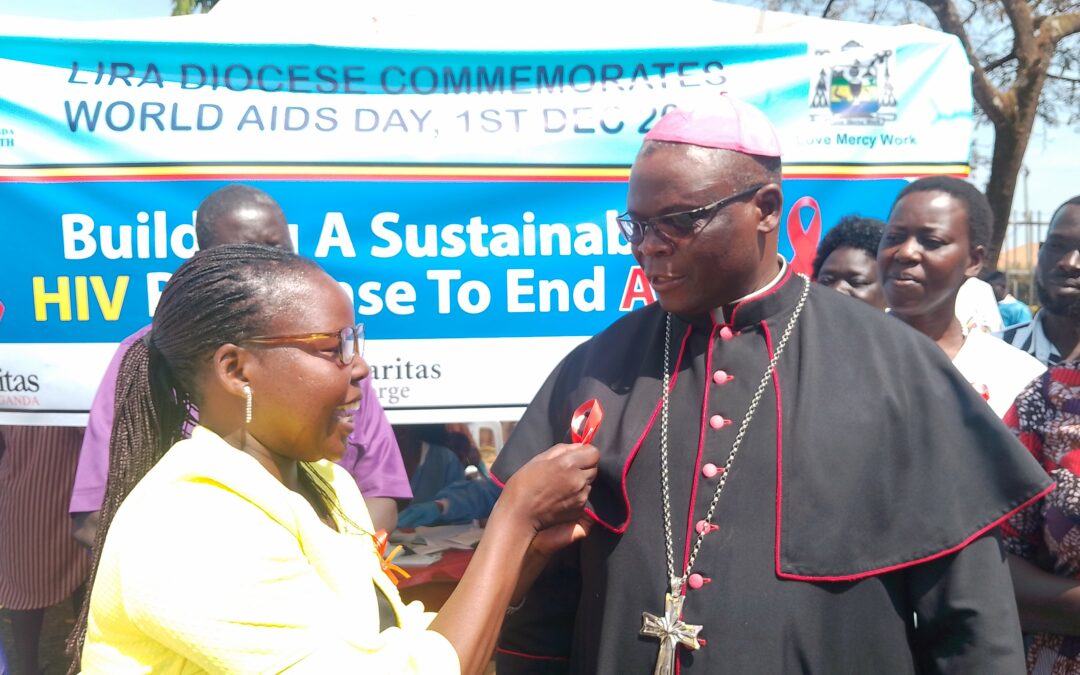
By Flavia Oyuu, Communications Office, Lira Diocese
LIRA CITY — As Uganda marks World AIDS Day on 1st December 2025, Lira Diocese has intensified its community HIV and Sickle Cell awareness efforts, testing over 400 people during a major pre-event held at Uganda Martyrs Cathedral.
The event was part of this year’s national theme:
“Building a Sustainable HIV Response to End AIDS.”
Bishop commissions Sickle Cell Task Force
After the third Mass at Uganda Martyrs Cathedral, the Bishop of Lira Diocese, Rt. Rev. Sanctus Lino Wanok, officially commissioned the Lira Diocese Sickle Cell Task Force, signaling the Diocese’s strengthened commitment to health as a foundation for development and evangelization.
He emphasized that without good health, families, Christians and communities cannot progress.
He outlined the Diocese’s six key pastoral pillars:
Health, Catechesis, Education, Caritas, Communication and Accountability.
“Without health, you cannot proceed. It is the basis of life for families, communities and the whole nation.”
“Communities must lead this fight” — Dina Apio
Speaking at the event, Ms. Dina Apio, the HIV Focal Person for Lira Diocese, said sustainability is crucial as donor funding continues to decline.
She outlined the Diocese’s community-centered strategy which includes massive HIV awareness, door-to-door and peer counselling, psychosocial support, training pastoral agents with accurate HIV information, household-level engagement
“When people understand the facts, they make informed decisions,” she said.
“This is how infections reduce.”
However, she noted an increase in Lost to Follow Up cases due to lack of guidance on where to get follow-up doses, domestic violence linked to HIV disclosure, stigma and occasional medicine shortages
Lira City’s progress — and rising danger
Lira City HIV focal person, Hillary Okello, said the city once had a 12% prevalence rate, prompting a coordinated response through the City AIDS Committee, radio programs, youth-focused outreach, and partnerships including HealthRight International and GLOFORD.
These efforts helped reduce the prevalence to 9%.
But the threat remains severe.
“This year we already have 350 new infections,” Hillary warned.
“If we continue like this, we risk returning to 12%.”
He acknowledged the Diocese’s support through the weekly Wa Clinic program on Radio Wa 89.8 FM.
Uganda and the global picture
- 40 million people living with HIV globally
- Uganda at 4.9% prevalence
- 1,000 new infections weekly
Dina stressed that national numbers do not reflect the “deep struggles” in rural and urban communities.
“We must respond urgently, and the community must be at the center.”
A call to action
Church and health leaders urged the public to:
- Test regularly
- Know their HIV status
- Enroll on treatment immediately if positive
- Adhere fully to medication
- Support those living with HIV
- Fight stigma at home and in society
The Diocese says this year’s World AIDS Day preparations reaffirm a simple truth: Ending AIDS requires not just funding, but community responsibility, unity and love.
Recent Comments